This documentation reflects the latest development version and may change before the next official release.
For the latest stable documentation, see 0.8.1-incubating.
Iceberg Format
Iceberg format refers to Apache Iceberg table, which is an open table format for large analytical datasets designed to provide scalable, efficient, and secure data storage and query solutions. It supports data operations on multiple storage backends and provides features such as ACID transactions, multi-version control, and schema evolution, making data management and querying more flexible and convenient.
With the release of Iceberg v2, Iceberg addresses the shortcomings of row-level updates through the MOR (Merge On Read) mechanism, which better supports streaming updates. However, as data and delete files are written, the read performance and availability of the table will decrease, and if not maintained in time, the table will quickly become unusable.
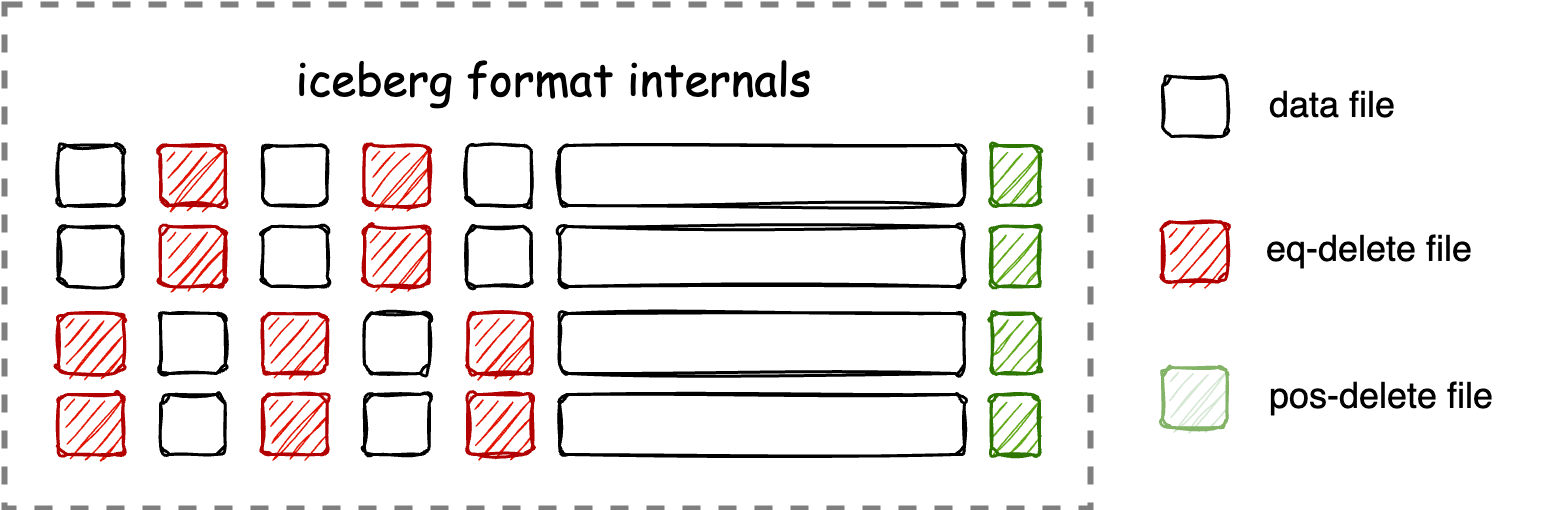
Starting from Amoro v0.4, Iceberg format including v1 and v2 is supported. Users only need to register Iceberg’s catalog in Amoro to host the table for Amoro maintenance. For detailed operation steps, please refer to Managing Catalogs. Amoro maintains the performance and economic availability of Iceberg tables with minimal read/write costs through means such as small file merging, eq-delete file conversion to pos-delete files, duplicate data elimination, and file cleaning, and Amoro has no intrusive impact on the functionality of Iceberg.
Format version compatibility
Amoro automatic maintenance supports Iceberg format versions 1 and 2. Format version 3 is not supported by the bundled Iceberg writer: a metadata commit can omit fields required by newer V3 readers and make the table inaccessible to those readers.
Amoro skips optimizing evaluation and planning for V3 tables and rejects their maintenance and optimizing commits. This also applies to a table upgraded while a transaction is committing. Recovery checks the table version before resuming optimizing jobs. If the catalog lookup fails, recovery continues with a warning; the writer still checks compatibility before committing. Snapshot expiration, dangling delete cleanup, data expiration, automatic tags, and orphan file cleanup are all blocked for unsupported tables.
The compatibility guard does not block catalog discovery or metadata reads and does not change the table’s maintenance settings. Read-only table summary collection remains available when optimizing is disabled and table summary collection is enabled. Loading and reading still depend on the features supported by the bundled Iceberg reader. The table name, unsupported version, and supported versions are reported in AMS logs; rejected maintenance and optimizing processes closed by the guard also use the existing failure or closure reporting. This protection does not repair metadata already written without required V3 fields.
Amoro supports all catalog types supported by Iceberg, including but not limited to: Hadoop, Hive, Glue, JDBC, Nessie, Snowflake, and so on.
Amoro supports all storage types supported by Iceberg, including but not limited to: Hadoop, S3, AliyunOSS, GCS, ECS, and so on.